Workplace noise exposure levels and time averages.
People experience workplace noise as fatigue, distraction, and long-term risk. That is why occupational noise monitoring is about more than compliance. It’s about protecting the people who keep work moving.
By measuring workplace noise exposure levels and time-weighted averages, we give safety professionals and employers the clarity they need to understand real exposure over a working day. Accurate, reliable data supports smarter controls, safer environments, and healthier outcomes.
Noise exposure at work acc. to 2003/10/EC and ISO 9612
Follow the Control of Noise at Work Regulations 2005
Confirm compliance with health standards ISO 1999
Measurement Functions
Sound Pressure Level SPL
for noise at work monitoring
LAeq (averaged sound level with A-weighting)
LCpeak (peak sound level with C-weighting)
Both levels are measured simultaneously, thus providing the base for comparison with the action limits listed below. The real-time spectrum analyzer provides detailed results about any annoying frequency band or exact frequency.
The optional XL3 Environmental bundle offers further noise levels as required:
Sound Exposure Level LAE
LCeq – LAeq
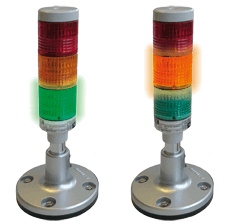
Stack Light
The XL2 forms with the Stack Light a stand-alone solution for noise at work monitoring applications. The Stack Light is controlled by the XL2. It alarms at exceeding sound levels, thus employees near the test station are notified immediately.
Noise Exposure Level LEX,8h
The Noise at Work Directive 2003/10/EC reduces the risk of hearing damage for employees. The action limits are
LEX,8h
LCpeak
Action
Lower limit value
80 dB(A)
135 dB
recommend wearing hearing protectors
Upper limit value
85 dB(A)
137 dB
hearing protectors must be worn and noise level reduced where possible
Exposure limit
87 dB(A)
140 dB
employee with hearing protectors shall never exceed these limits
Determination of Noise Exposure Level LEX,8h:
With a consistent noise level (applies when LAS deviation is < 5 dB)
Measure the LAeq over a few minutes, the resulting LAeq represents the noise exposure level of the complete 8 hours period LEX,8h = LAeq. Where the daily exposure time T ≠ 8 hours, apply the following formula:
LEX,8h = LAeq + 10 x log ( T / 8 hours )
With stepwise consistent level variations
(applies to steady noise at clearly distinguishable levels)
Measure the LAeq at the different levels and note the corresponding exposure time. Enter all data in the NTi Audio noise exposure level post processing form; the LEX,8h will be calculated and displayed.
For varying noise levels:
LEX,8h = LAeq measured for 8 hours
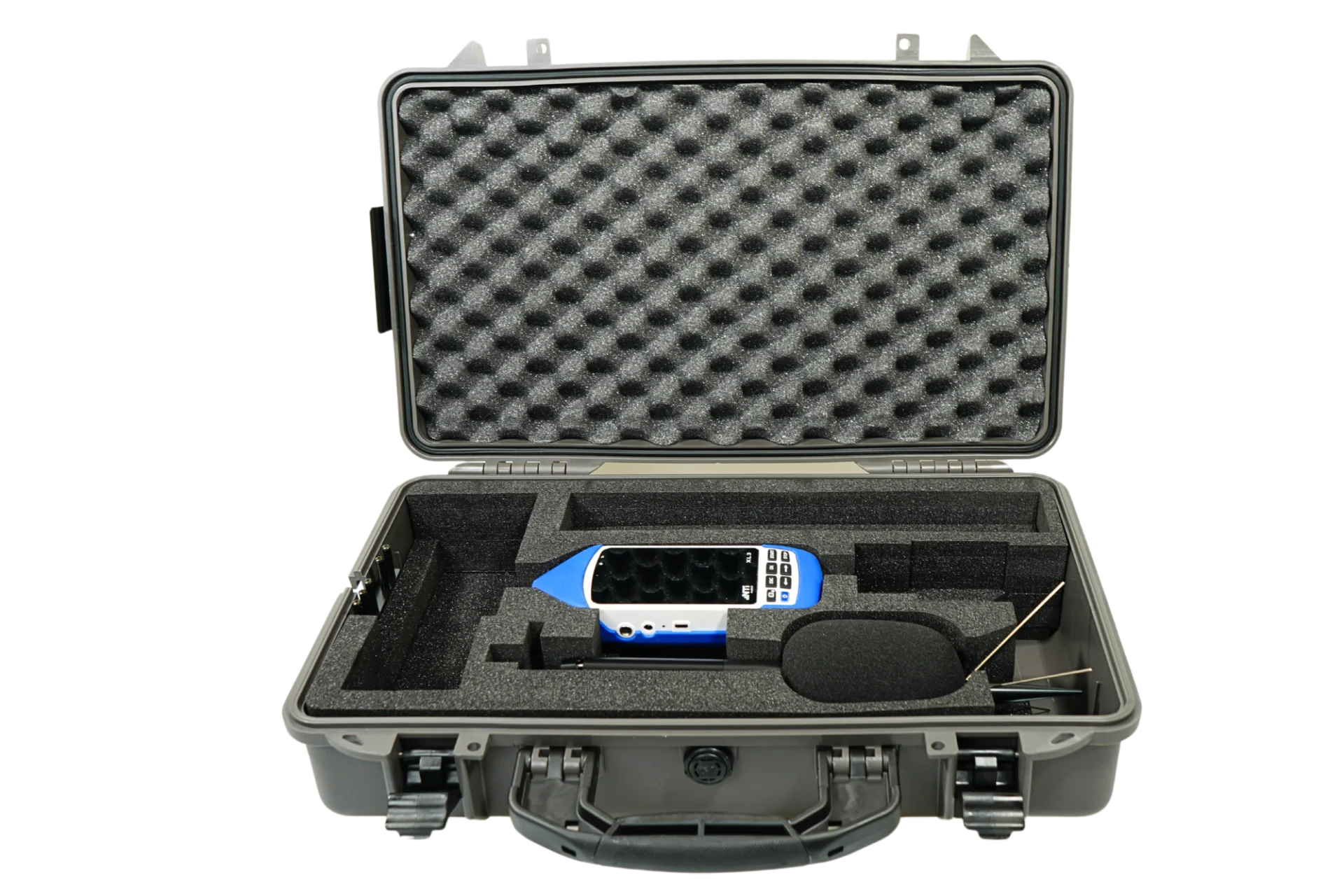
Configuration
including
XL3 Sound Level Meter
M4262 class 2 Measurement Microphone or M2230 class 1 Measurement microphone
System Case or Backpack
Optional as required:
XL3 Environmental bundle
with additional features for sound level logging and post processing software